

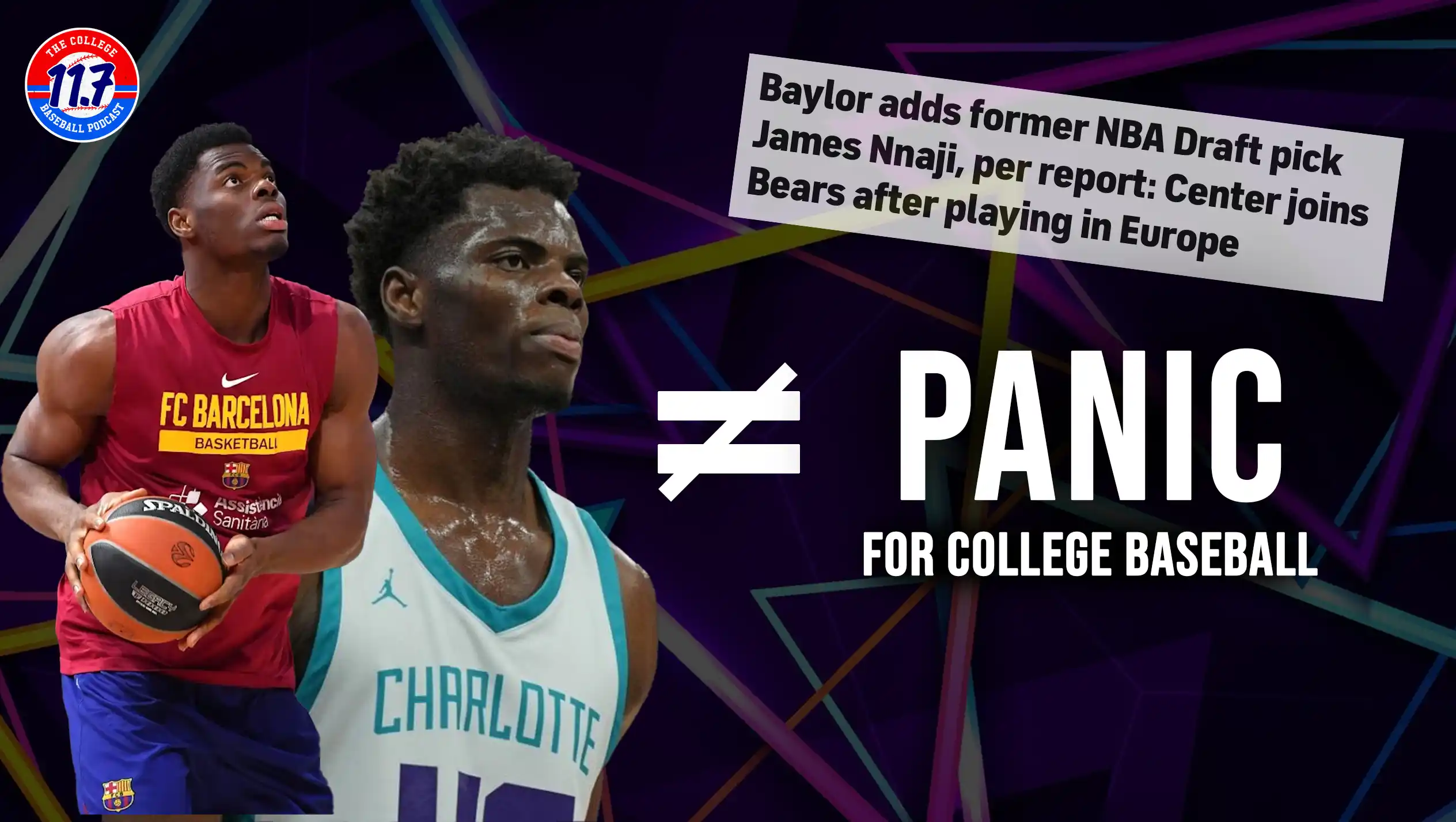
The news of James Nnaji enrolling at Baylor has gone viral.
Former NBA draft pick. Back in college. Immediate eligibility.
Words like dangerous precedent getting tossed around like everyone just woke up to a broken system.
Let’s start with the basics.
James Nnaji never signed an NBA contract. He never played in an official NBA regular-season game. His rights were traded, yes, but that alone does not end amateur status under NCAA rules. Draft status — even being selected — has never been the determining factor. Contracts and compensation are.
That distinction matters, and it’s getting lost in the noise.
There are examples of players who ran into compliance issues after playing professionally in Europe — Enes Kanter being the most cited — but there are also multiple cases where international players were deemed eligible after review. The precedent isn’t new, even if the visibility is.
And from a college baseball perspective, the panic feels misplaced.
College baseball has lived in the space between amateur and professional for decades.
High school players get drafted.
Some sign.
Some don’t.
Some go to college, get drafted again, and return to school if they don’t like the deal.
So the idea that a player can brush up against the professional world and still return to college isn’t some radical shift. It’s foundational to how baseball development works in the United States.
Basketball fans are reacting like a door just got kicked open, largely because this scenario is rare in their sport — and because Nnaji appeared in summer league games while negotiating a contract that ultimately never got signed.
That’s an important nuance.
In baseball, a player cannot appear in minor league games without putting pen to paper on a professional contract. The line is clear. In basketball, it’s more fluid, and that fluidity is now being tested publicly.
It’s also worth remembering that baseball is the outlier among the major sports. The NBA and NFL both require players to formally declare for the draft, and once they do, NCAA eligibility is gone. Baseball is the only one of the “Big Three” where a drafted player can return to school.
daSo the panic and attention should be directed to seeing if the NCAA will adjust it's bylaws to allow NBA draft picks to maintain NCAA eligibilty.
The other piece driving the Nnaji conversation is overseas professional experience — and whether that should permanently disqualify an athlete from NCAA competition.
Again, college baseball has already dealt with this.
The perception problem is that European professional basketball is widely respected and clearly labeled as “pro,” while international baseball leagues are still incorrectly dismissed as semi-pro or developmental. In reality, that distinction has never mattered to NCAA compliance.
International baseball players have long come through:
And then enrolled and competed in NCAA baseball.
The line between “professional” and “amateur” has never been clean internationally. Baseball adjusted. It didn’t collapse. If anything, the sport benefitted from broader talent pools, older players, and more mature competition.
If this is a dangerous precedent, it’s one college baseball has been managing quietly — and successfully — for years.
Very little.
This doesn’t suddenly mean:
Those incentives still don’t exist. Development timelines still matter. Opportunity cost still matters. Most professional-caliber players have no reason to reverse course.
If anything, situations like this reinforce what baseball already accepts: development paths are individual, not uniform.
The Nnaji situation is meaningful for college basketball. It forces that sport to confront flexibility it hasn’t had to deal with before.
For college baseball, it’s mostly a reminder.
The system has always been imperfect. The rules have always required nuance. And the sport has navigated those realities without losing credibility or competitive integrity.
So while other sports are reacting like this is the start of something dangerous, college baseball doesn’t need to panic.
This isn’t a new precedent.
It’s just one that basketball is finally catching up to.
And if history is any indication, college baseball will be just fine.

The news of James Nnaji enrolling at Baylor has gone viral.
Former NBA draft pick. Back in college. Immediate eligibility.
Words like dangerous precedent getting tossed around like everyone just woke up to a broken system.
Let’s start with the basics.
James Nnaji never signed an NBA contract. He never played in an official NBA regular-season game. His rights were traded, yes, but that alone does not end amateur status under NCAA rules. Draft status — even being selected — has never been the determining factor. Contracts and compensation are.
That distinction matters, and it’s getting lost in the noise.
There are examples of players who ran into compliance issues after playing professionally in Europe — Enes Kanter being the most cited — but there are also multiple cases where international players were deemed eligible after review. The precedent isn’t new, even if the visibility is.
And from a college baseball perspective, the panic feels misplaced.
College baseball has lived in the space between amateur and professional for decades.
High school players get drafted.
Some sign.
Some don’t.
Some go to college, get drafted again, and return to school if they don’t like the deal.
So the idea that a player can brush up against the professional world and still return to college isn’t some radical shift. It’s foundational to how baseball development works in the United States.
Basketball fans are reacting like a door just got kicked open, largely because this scenario is rare in their sport — and because Nnaji appeared in summer league games while negotiating a contract that ultimately never got signed.
That’s an important nuance.
In baseball, a player cannot appear in minor league games without putting pen to paper on a professional contract. The line is clear. In basketball, it’s more fluid, and that fluidity is now being tested publicly.
It’s also worth remembering that baseball is the outlier among the major sports. The NBA and NFL both require players to formally declare for the draft, and once they do, NCAA eligibility is gone. Baseball is the only one of the “Big Three” where a drafted player can return to school.
daSo the panic and attention should be directed to seeing if the NCAA will adjust it's bylaws to allow NBA draft picks to maintain NCAA eligibilty.
The other piece driving the Nnaji conversation is overseas professional experience — and whether that should permanently disqualify an athlete from NCAA competition.
Again, college baseball has already dealt with this.
The perception problem is that European professional basketball is widely respected and clearly labeled as “pro,” while international baseball leagues are still incorrectly dismissed as semi-pro or developmental. In reality, that distinction has never mattered to NCAA compliance.
International baseball players have long come through:
And then enrolled and competed in NCAA baseball.
The line between “professional” and “amateur” has never been clean internationally. Baseball adjusted. It didn’t collapse. If anything, the sport benefitted from broader talent pools, older players, and more mature competition.
If this is a dangerous precedent, it’s one college baseball has been managing quietly — and successfully — for years.
Very little.
This doesn’t suddenly mean:
Those incentives still don’t exist. Development timelines still matter. Opportunity cost still matters. Most professional-caliber players have no reason to reverse course.
If anything, situations like this reinforce what baseball already accepts: development paths are individual, not uniform.
The Nnaji situation is meaningful for college basketball. It forces that sport to confront flexibility it hasn’t had to deal with before.
For college baseball, it’s mostly a reminder.
The system has always been imperfect. The rules have always required nuance. And the sport has navigated those realities without losing credibility or competitive integrity.
So while other sports are reacting like this is the start of something dangerous, college baseball doesn’t need to panic.
This isn’t a new precedent.
It’s just one that basketball is finally catching up to.
And if history is any indication, college baseball will be just fine.


